
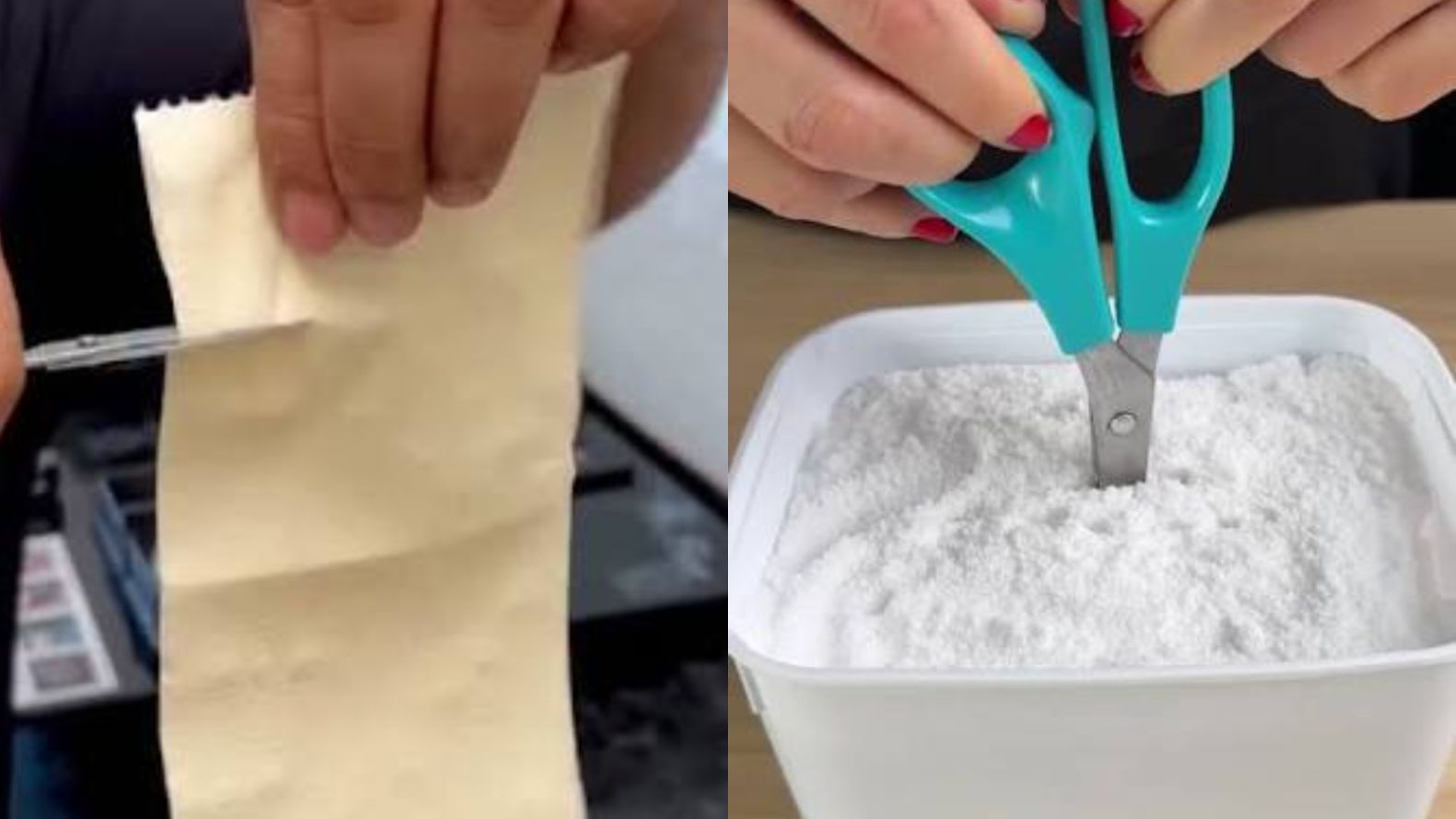

You can easily restore the edge of slightly dull or blunt household scissors using quick kitchen and workshop hacks—no need to buy a sharpening stone or replace them. The viral salt trick works well for minor honing, but there are several other highly effective homemade methods you can try. Whether your scissors are just slightly dull or tearing paper instead of cutting it cleanly, one of these five techniques will get them back to slicing smoothly in minutes.
The salt hack is perfect for a quick, mild tune-up. Fill a small, sturdy glass jar or cup with coarse rock salt, insert the open scissor blades straight into the salt, and firmly grip the handles while making slow, controlled opening and closing motions—as if you are “cutting” the salt—for about 1 to 2 minutes. The crucial next step is to rinse and dry the blades immediately with a clean cloth, because salt is highly corrosive to metal and leaving any residue or moisture behind will cause the steel to rust. If your scissors are noticeably blunt, the toothpaste and ceramic mug method offers a step up. Coat both blades evenly with a layer of standard white toothpaste (which contains mild abrasives like silica) and a pinch of table salt for extra grit, and let it sit for 2 minutes. Flip a ceramic mug upside down to expose the rough, unglazed ring on the bottom, hold the scissor blade at a 40-degree angle—perfectly matching the original slanted bevel—and stroke it firmly across the ceramic ring 30 to 40 times. Wipe clean with a damp paper towel and your scissors will have a noticeably sharper edge.
For a zero-mess option that requires no cleanup, the aluminum foil cut is your best bet. Take a piece of aluminum foil about 8–10 inches long and fold it lengthwise multiple times until you have a thick, layered strip. Use full scissor strokes—starting from the very base of the blades all the way to the tips—to cut the foil into many thin strips. The friction against the layered metal sheets realigns the microscopic burrs on the edges, sharpening them instantly. When your scissors are tearing paper instead of cutting it cleanly, you need a slightly rougher abrasive texture: take a sheet of medium-grit sandpaper (around 150 to 220 grit), fold it in half so the rough, gritty sides face outwards on both sides, and cut through the folded sandpaper 10 to 20 times using full, sweeping cuts. Wipe the blades down with a damp cloth afterward to clear away loose grit particles.
Finally, the glass bottle or mason jar trick is a quick fix for a rough edge. Open your scissors wide and place the blades around the neck of a sturdy glass bottle, mason jar, or even a thick metal screwdriver. Close the scissors gently, applying very light pressure as if you are trying to cut the glass neck, letting the bottle slide out as the blades close. Repeat this motion 15 to 20 times to quickly hone the edge. With all of these methods, remember to clean and dry your scissors thoroughly afterward, and avoid cutting anything harder than the materials the scissors were designed for. By rotating through these simple household hacks, you can keep every pair of scissors in your home sharp, functional, and ready to use—without ever spending money on professional sharpening.
